MyRugStudio journal · 19 October 2026
What makes a
great rug design?
A pattern can be simple or intricate and still work beautifully. What matters is how its parts relate to one another—and to the room it will live in.
There isn’t a formula that makes every rug good. These are useful ways to make decisions when you’re faced with a blank canvas. The museum and design references below provide context; the studio exercises are our suggestions for trying the ideas yourself.
Choose a structure before adding details
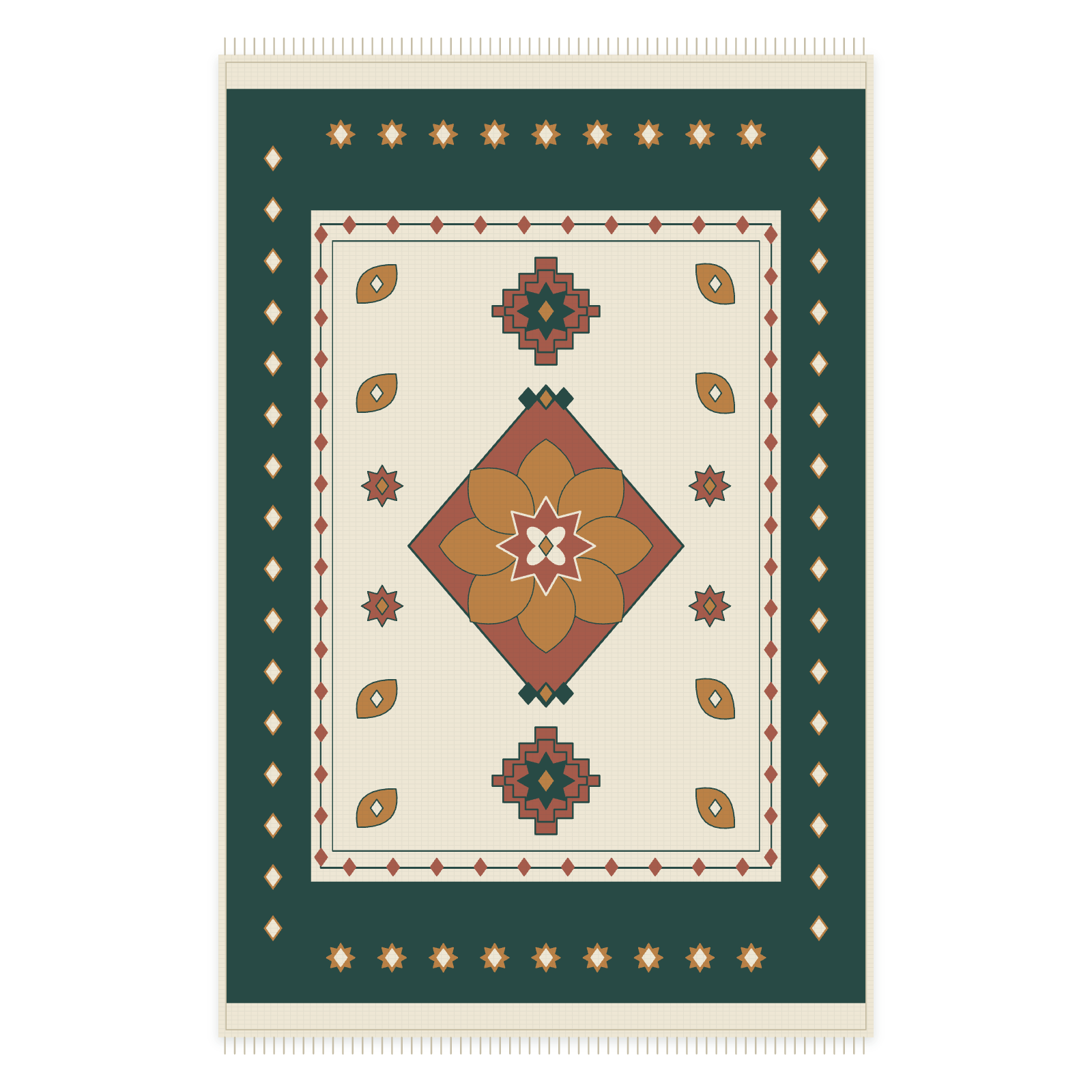
Decide whether you want a central motif, an even spread of repeated shapes, or a border around a quieter field. It gives your smaller choices something to belong to.
The V&A’s account of the Ardabil Carpet describes a central medallion, related corner compositions, and a border with four bands. It is one historical example of a complex pattern organized around a clear structure, rather than a template every rug needs to follow.
In the studio: Place a large medallion first, or repeat one motif across the field. Work on that arrangement before mixing in several new shapes.
Give the eye somewhere to begin
When every motif is equally large and equally prominent, the design can be hard to read. Try a larger main shape, medium supporting shapes, and small accents. Then zoom out and see what you notice first.
Nielsen Norman Group explains how scale, hierarchy, balance, and contrast organize visual compositions. Its article concerns interface design; using those concepts to assess a rug is our application of the same visual ideas.
In the studio: Make one motif noticeably larger than the others. If it dominates too much, reduce its size or soften its color before adding more detail.
Make color choices in relation to each other
As an exercise, start with a background and two motif colors. Repeat those colors in different parts of the rug before introducing another. This is a manageable starting point, not a limit on how many colors a good design can contain.
Try changing the background while leaving the motifs alone. A dark outline against a light field reads differently from two colors of similar lightness. NN/G’s discussion of contrast is useful here: visual differences can make some elements stand apart from others.
In the studio: Use the Color controls to compare a pale and a dark background. Ask which parts of the pattern remain clear at the smaller preview size.
Use repetition with a purpose
Repeating a motif makes it feel related to the rest of the composition. Spacing changes that relationship: a tight repeat can read as texture, while wider spacing lets each shape stand on its own. A border may need a different rhythm from the center.
Try consistent spacing first, then change one thing at a time. Symmetry can help you establish an arrangement, but a design doesn’t have to be symmetrical to feel balanced.
In the studio: Compare Single, Around center, and Rows & columns using the same motif. Change Repeat spacing rather than immediately adding another family of shapes.
Think about what will actually be visible
A beautiful center might sit beneath a coffee table. A narrow runner offers a different canvas from a round rug. Sketch the furniture layout and measure the floor area before committing to dimensions.
Ruggable’s rug size guide illustrates common arrangements for living rooms, bedrooms, and dining spaces. It is a retailer’s guide to its own products, but the layout examples are useful for thinking through placement.
Before production: Ask your maker about minimum detail size, materials, and color samples. A screen preview is a design reference; the final yarn and construction need to be agreed with the person making the rug.
A first design exercise
Open a featured design and change only its background and two motif colors. Save a backup, then make a second version with a different scale or spacing. Compare them at a small size and decide which one you would prefer in your room. Keeping versions makes it easier to experiment without losing something you liked.
Try the design studio ↗Sources and further reading
- Victoria and Albert Museum: The Ardabil Carpet — historical composition, borders, and craftsmanship.
- Kelley Gordon, Nielsen Norman Group: 5 Principles of Visual Design in UX — scale, hierarchy, balance, and contrast.
- Ruggable: Rug Size Guide — furniture layouts and rug placement.
Sources checked on 19 October 2026. These are independent references, not endorsements of MyRugStudio. The illustrated rug is our own studio design.